
Our Products Make Your Product Better®

Related Products
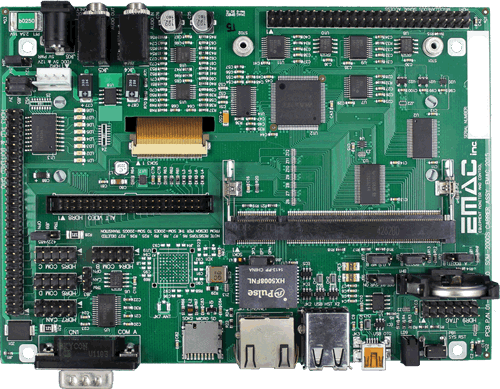
The SoM-200GS is a compact, low-power SoM Carrier/Socket board with a optional 4.3 inch WQVGA (480 x 272) color LCD and resistive touch screen. This versatile SoM Carrier/Socket board is ideal for evaluation and early development work. This Carrier is designed to work with all EMAC 200-pin SODIMM type SoMs. Note: The SoM-200GS is specifically designed for SoMs with Video & USB capability.
The SoM-200GS provides access to much of the SoM's I/O through on-board connectors as well as a number of additional I/O expansion blocks such as Video, Touchscreen, Wireless Networking, Gigabit Ethernet and Micro HCSD/MMC flash disk.
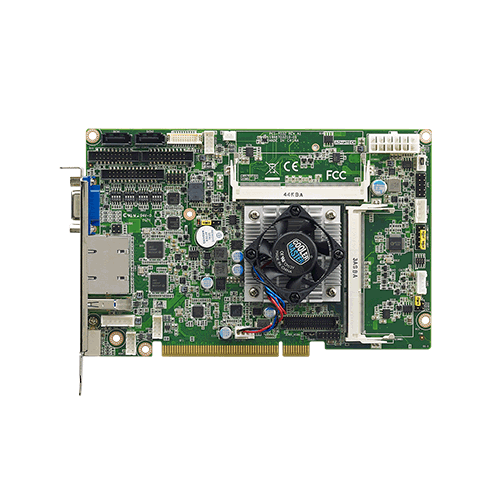
PCI-7032 is an Intel® based PICMG 1.0 half-size PCI interface single board computer. PCI-7032G2, with Intel® Celeron® J1900, offers a dual GbE LAN, high computing solution; PCI-7032VG, adopting Intel® Atom® N2930, provides a single GbE LAN and fanless computing core with high reliability that resists heat, dust, vibration and shock in any application environment.
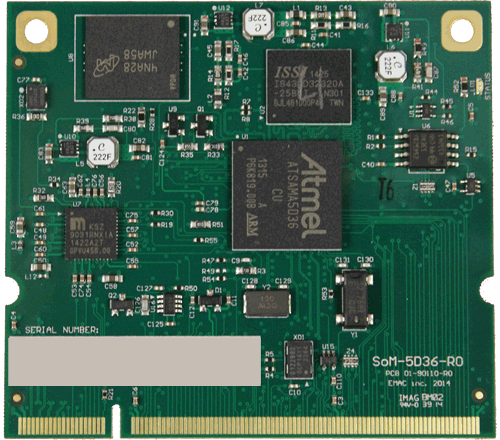
The SoM-A5D36 is a System on Module (SoM) based on the Atmel ARM Cortex A5 ATSAMA5D36 processor.

Yocto
The Yocto Project is an open source collaboration project that provides templates, tools and methods to help you create custom Linux-based systems for embedded products regardless of the hardware architecture. It was founded in 2010 as a collaboration among many hardware manufacturers, open-source operating systems vendors, and electronics companies to bring some order to the chaos of embedded Linux development.
As an open source project, the Yocto Project operates with a hierarchical governance structure based on meritocracy and managed by its chief architect, Richard Purdie, a Linux Foundation fellow. This enables the project to remain independent of any one of its member organizations, who participate in various ways and provide resources to the project.
Why use the Yocto Project? It's a complete embedded Linux development environment with tools, metadata, and documentation - everything you need. The free tools are easy to get started with, powerful to work with (including emulation environments, debuggers, an Application Toolkit Generator, etc.) and they allow projects to be carried forward over time without causing you to lose optimizations and investments made during the project’s prototype phase. The Yocto Project fosters community adoption of this open source technology allowing its users to focus on their specific product features and development.
The Yocto Project provides resources and information catering to both new and experienced users, and includes core system component recipes provided by the OpenEmbedded project. The Yocto Project also provides pointers to example code built demonstrating its capabilities. These community-tested images include the Yocto Project kernel and cover several build profiles across multiple architectures including ARM, PPC, MIPS, x86, and x86-64. Specific platform support takes the form of Board Support Package (BSP) layers for which a standard format has been developed. The project also provides an Eclipse IDE plug-in and a graphical user interface to the build system called Hob.

